
FAQ|Airborne Particle Counter Procurement Questions
Q1: What is the working principle of an airborne particle counter? Q2: What are the applications of airborne particle counters? Q3: How to select airborne particle counters for different industries? Q4: What are the features of HjClean airborne particle counters? Q5: How to choose between handheld, portable desktop and online monitoring systems? Q6: Is technical support available after purchase?
Q1: What is the working principle of an airborne particle counter?
A: Airborne particle counters work based on the laser light scattering principle. When laser irradiates suspended particles in the air, light scattering occurs. The larger the particle surface area, the stronger the scattered light. The instrument captures light signals, performs photoelectric conversion and calculation, counts particles of different sizes per unit volume, and determines the cleanliness class. HJCLEAN online monitoring systems, portable desktop and handheld particle counters all adopt this proven technology for stable and reliable measurement.
Q2: What are the applications of airborne particle counters?
A: As core testing equipment for cleanrooms and laboratories, it is mainly used for: acceptance testing of newly-built or renovated clean workshops; routine workshop inspection to detect cleanliness abnormalities in time; providing traceable test data for GMP audits and customer factory audits; troubleshooting purification systems such as air conditioning and HEPA filters.
Q3: How to select airborne particle counters for different industries?
A:
· Pharmaceutical & Biotech Industry: Must comply with GMP requirements and ensure traceable data. Select portable desktop models with built-in printers for routine inspection; deploy online airborne particle monitoring systems for long-term monitoring in aseptic filling zones; choose handheld models for multi-point mobile sampling. Large-flow models (28.3L/min, 50L/min, 100L/min) are recommended.
· Electronics & Semiconductor Industry: Tiny particles may lead to chip rejection. Prioritize multi-channel models capable of detecting ultra-fine 0.1μm particles. Online monitoring systems can be equipped for large-area workshops.
· Food & Cosmetic Industry: For periodic sampling in clean workshops, portable models with standard 2.83L/min flow rate are cost-effective.
· Optics & Aerospace Industry: Test points are widely distributed. A combination of handheld and portable desktop counters is recommended. Handheld units for rapid patrol inspection; desktop units for precise testing and acceptance documentation at key workstations.
Q4: What are the features of HjClean airborne particle counters?
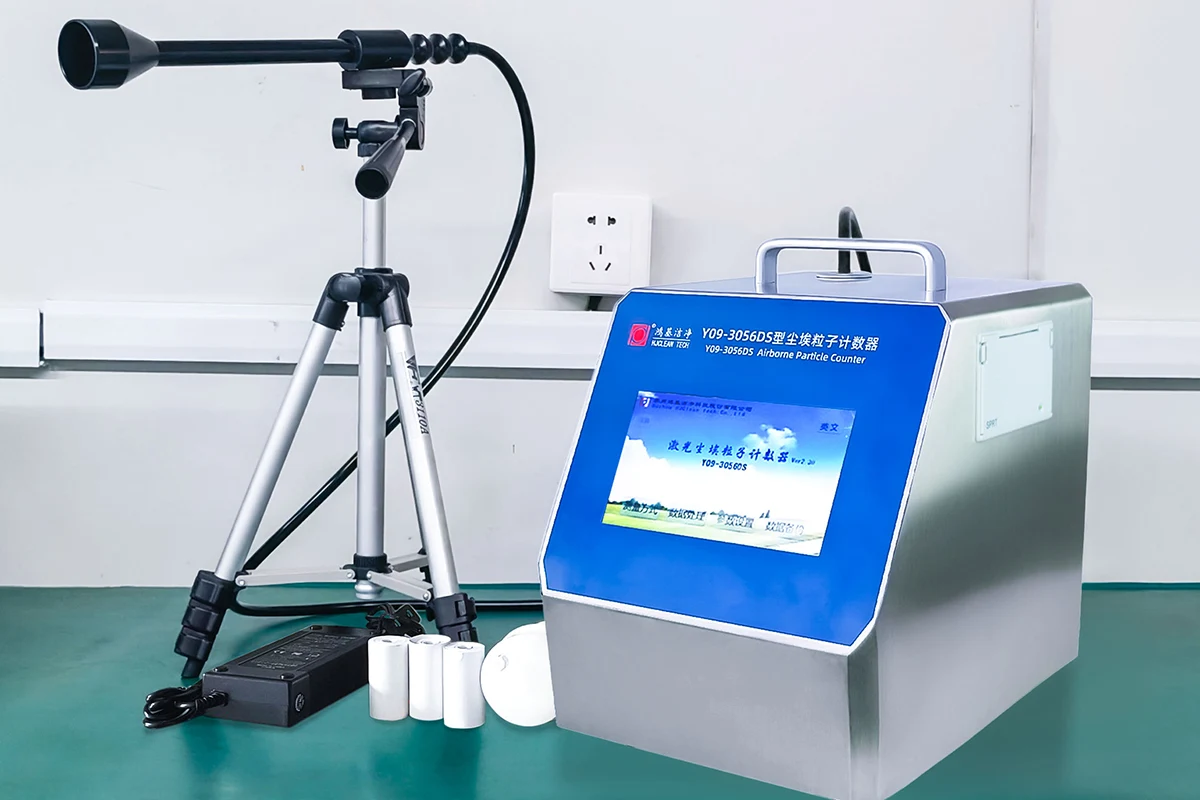
A: HJClean provides a full product portfolio including online airborne particle monitoring systems, portable desktop and handheld counters. Our flagship Y09 series covers desktop models Y09-316DS, Y09-516DS, Y09-3056DS and handheld model Y09-3106H.
DS versions adopt stainless steel housing with built-in dot matrix printers to print test reports on site. It supports multiple sampling flow rates from 2.83L/min to 100L/min and detects particle sizes of 0.1μm, 0.3μm, 0.5μm, meeting cleanroom testing demands across various industries.
Q5: How to choose between handheld, portable desktop and online monitoring systems?
A:
· Multi-point mobile inspection & field sampling: Handheld airborne particle counter
· Fixed-point testing, project acceptance and hard-copy report archiving: Portable desktop model
· 24/7 continuous monitoring for high-standard cleanrooms: Online airborne particle monitoring system
Q6: Is technical support available after purchase?
A: HJClean offers equipment operation training and on-site technical guidance to help customers perform cleanroom testing and interpret data, supporting acceptance and daily operation.