
Product Introduction
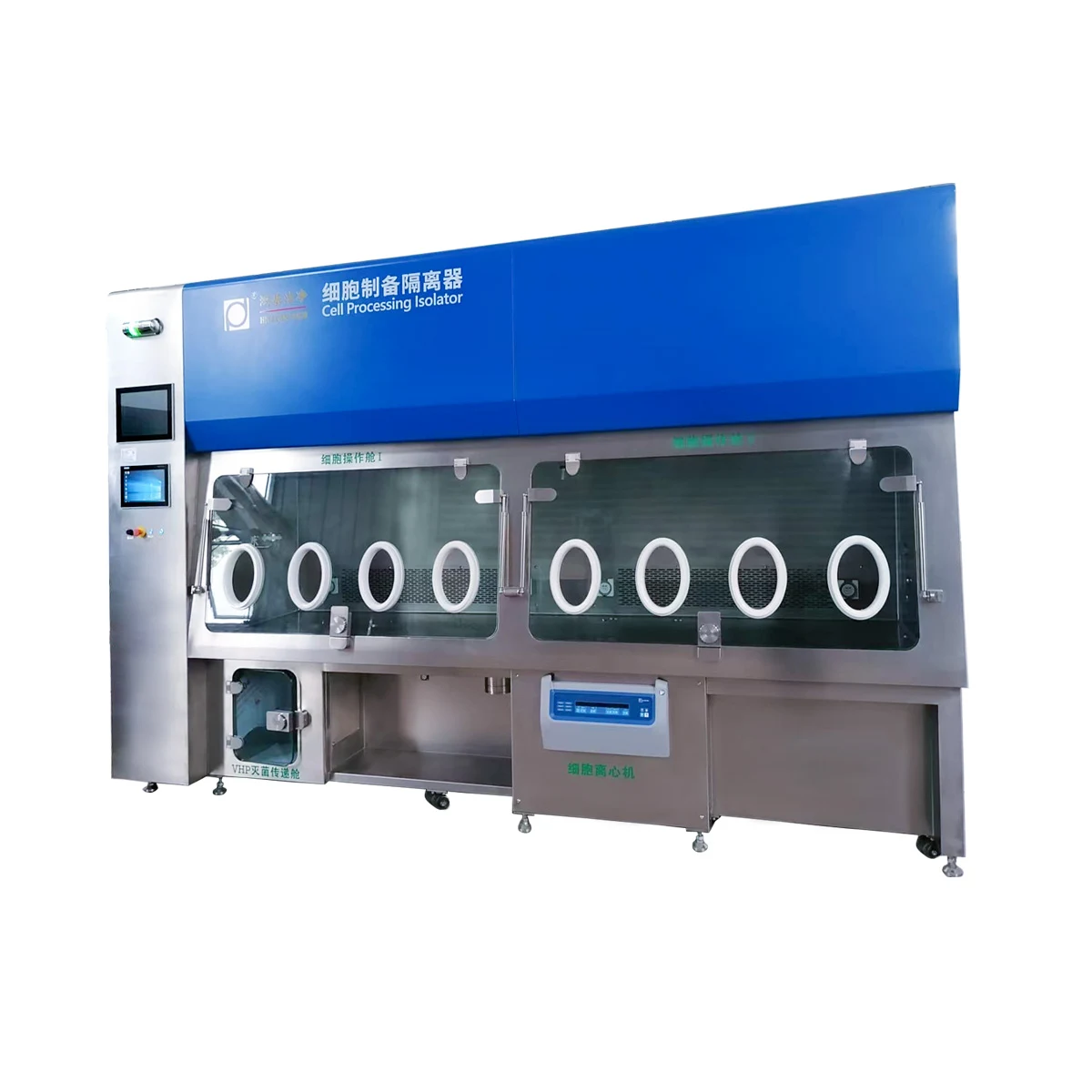
The cell processing isolator is specialized equipment for cell production, extraction, observation and cultivation under an aseptic environment. It is designed to eliminate exogenous microorganisms while protecting cells from damage and contamination. It enables rapid cell growth and maintains maximum aseptic conditions for operators and the surrounding environment during production. It is a multi-functional environmental process equipment.
System Components
The cell processing system consists of an aseptic isolator, honeycomb cell culture system, transfer system, information management system and other components.
Inside the aseptic isolator are equipped with a centrifuge, liquid handling system, solution preparation system, sampling and microscopy system, as well as a sterilization system, residue removal system, laminar flow system, control and monitoring system. Operations can be performed automatically by robotic manipulators, with manual operation via glove ports as supplement.
The honeycomb culture system comprises mobile incubators, CO₂ culture system, honeycomb racks and other parts.
Configurations and specifications
Cleanliness class | ISO5 classA |
Display panel | Tempered glass, 15 mm |
Filter level | HEPA≥99.995%,@0.3um |
Decontamination time of the operating compartment | 2h |
illuminance | >500lx |
Power supply | 380V 50Hz |
Pressure differential | 20–80 Pa |
Adjustable chamber material | SUS316L stainless steel |
Description of the cell preparation process
1.Connect the honeycomb incubator to the isolator; apply an air-sealing seal to secure and seal the honeycomb incubator; initiate hydrogen peroxide sterilization to sterilize the outer surface of the honeycomb incubator and remove any residual contaminants.
2.Using gloves, open the inner docking door of the honeycomb unit, then open the door of the honeycomb incubator, remove the culture flask, and scan the QR code to retrieve cell information.
3.On one hand, close the inner docking door, activate the sterilization system, and sterilize the interior of the honeycomb incubator. On the other hand, within the operation cabin, open the centrifuge door, place the culture flask into the centrifuge, close the centrifuge door, and initiate centrifugation.
4.After centrifugation is complete, open the centrifuge door, remove the centrifuged culture flask, and position it in the pipetting module.
5.Activate the waste-removal program of the pipetting module, extract the centrifuged waste liquid and transfer it to the waste container, then transfer a small quantity of cells onto a glass slide for microscopic examination and cell counter analysis.
6.Activate the nutrient-replenishment program of the pipetting module, add sterile nutrient medium to the culture flask, rinse the flask to dislodge adherent cells from the flask walls, and split one culture flask into two separate flasks.
7.Cap the nutrient-replenished culture flask, return it to the honeycomb incubator, close the incubator door, close the inner docking door, release the air-sealing strip of the outer docking door, and relocate the honeycomb incubator to the designated culture station.
8.Within the isolator, use a microscope to examine the cell morphology and count the cell population, and record the batch-specific cell data in the system.
9/After cleaning the pipettes, sampling specimens, and other equipment, await the arrival of the next honeycomb unit.
10.After a period of culture, once the cell culture volume has reached the desired amount, the waste liquid may be drained using a pipetting module, and the cultured cells may then be directly transferred from the isolator to a cryopreservation chamber for storage.